Family’s fancy fields monarch butterfly fleet - Toledo Blade
 Susan Garn stands near the milkweed plants that the monarch caterpillars feed on at her Perrysburg home.
THE BLADE/AMY E. VOIGTEnlarge | Buy This Photo
 A newly hatched Monarch butterfly dries its wings after exiting its chrysalis at the Garn home in Perrysburg.
THE BLADE/AMY E. VOIGTEnlarge | Buy This Photo
Read more at http://www.toledoblade.com/local/2014/09/01/Family-s-fancy-gives-flight-to-monarch-butterfly-fleet.html#7Gl02S8fz74g7YmO.99
Susan Garn picked up a monarch butterfly that had just emerged from its chrysalis Wednesday but couldn’t quite fly yet. She held it up in the palm of her hands and let it float away.
 Susan Garn stands near the milkweed plants that the monarch caterpillars feed on at her Perrysburg home.
THE BLADE/AMY E. VOIGTEnlarge | Buy This Photo
Motherly love is exactly what she gave 158 monarch butterflies that went through the Garn family protection service from egg to monarch. After tending to zero monarchs last summer because of freezing temperatures in Mexico, Mrs. Garn was worried this year would be the same. Then came late June when she found the first ones in the front shrubs.
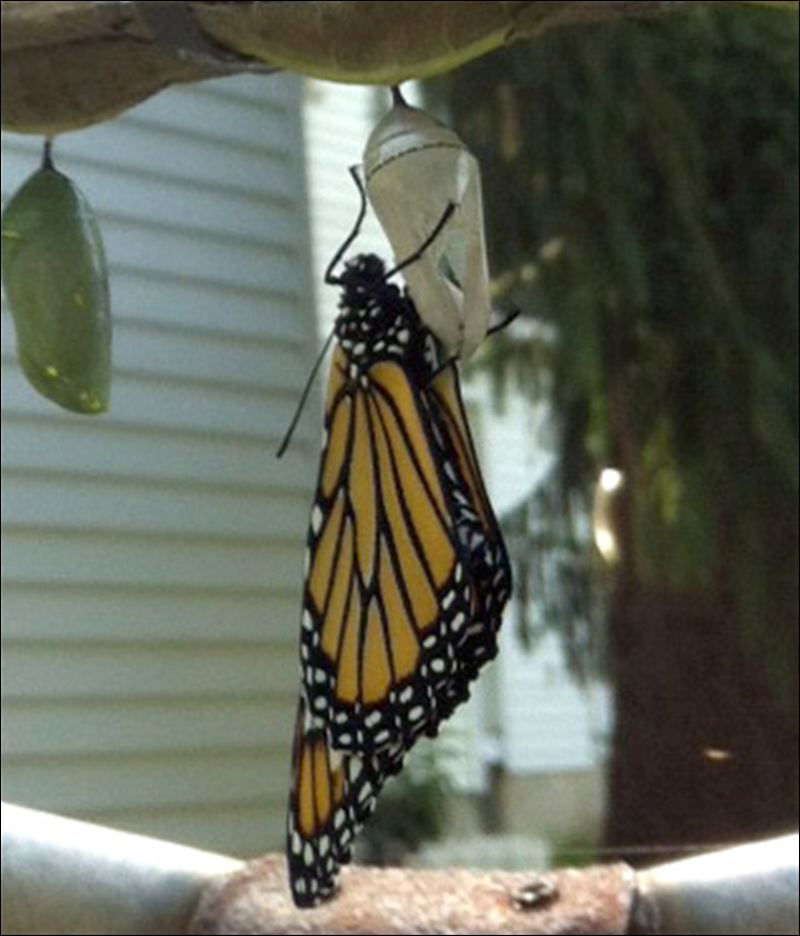 A newly hatched Monarch butterfly dries its wings after exiting its chrysalis at the Garn home in Perrysburg.
THE BLADE/AMY E. VOIGTEnlarge | Buy This Photo
“Grant, Grant,” she shouted to her husband before marking her calendar and calling her four children to tell them monarchs were laying eggs again this summer.
It was exciting news because the monarch population, according to Monarch Watch, which promotes the creation, conservation, and protection of monarch habitats from the University of Kansas, had an all-time low last year.
“We’re finding increased reports in all parts of the country,” said Chip Taylor, founder and director of Monarch Watch. “It is a definite rebound.”
Mr. Taylor said the monarch population is declining because of a loss of habitat, from a half a million to a million and a half acres a year in America.
The Garns, a retired couple who live in Perrysburg, do everything they can to keep monarchs coming back. They’ve encouraged others to get milkweed plants too, which is the only thing the monarch caterpillars eat.
Three times a day, Mrs. Garn checks the plants for eggs so she can protect them in a tub inside before insects eat the eggs first.
“I don’t have the eyesight to see those egg specks,” Mr. Garn said. “I’m the mechanical side of things.”
His role is to take the monarchs, while in the chrysalis stage, from inside containers to an outdoor clothesline. The outdoor clothesline has four rows of them ready to emerge into beautiful orange, black, and white monarch butterflies that will leave for Mexico.
Mr. Garn moves the chrysalises by delicately tying string around the top attaching part and then tying or duct-taping the string to wood on the clotheslines.
Mrs. Garn, two years ago retired from Perrysburg High School as a biology teacher, said even though she only sees them for a few minutes before they fly to Mexico, it is special. She compared it to having a short period of time to have a large impact on her students lives.
After they had no monarchs last year, the couple was excited to care for so many butterflies this year.
Tending to the butterflies is something hard to let go as the Garns’ soon leave to travel up north.
“I may sneak some in the car,” Mrs. Garn said in a whisper. “I just want to see what happens to them.”
Read more at http://www.toledoblade.com/local/2014/09/01/Family-s-fancy-gives-flight-to-monarch-butterfly-fleet.html#7Gl02S8fz74g7YmO.99
Comments
Post a Comment